Market Research and Development Trends of Oriented Silicon Steel Industry
Analysis and Forecast of Downstream Sub-market Applications in the Grain-Oriented Silicon Steel Industry
China’s steel industry has entered a stage of fierce competition for
existing market share. In 2023, crude steel production reached 1.005
billion tons, and steel product output reached 1.4 billion tons,
representing a year-on-year increase of 1.1%. Driven by technological
and industrial revolutions, the steel industry is accelerating
structural upgrading and developing towards mid-to-high-end products. On
the consumption side, demand for construction steel has declined, while
demand for high-quality special steels such as medium and heavy plates,
automotive steel sheets, and silicon steel has increased. High-end
steel will become the main focus of future development, and
grain-oriented silicon steel is expected to become a key development
area for the steel industry.
Analysis of the supply situation of my country’s grain-oriented silicon steel industry
Silicon steel is an indispensable soft magnetic alloy material for
national industry, agriculture, transportation, national defense, and
people’s daily lives. It is the cornerstone of the green, low-carbon,
and efficient development of the power industry and a key material for
upgrading various electrical products. It is widely used in industrial
motors, home appliances, new energy vehicles, transformers, and other
fields.
Gross-oriented silicon steel, due to its high magnetic
permeability, low coercivity, and high resistivity, is widely used in
various types of transformers, including main transformers, distribution
transformers, and dry-type transformers, primarily in the transformer
(core) manufacturing industry. The manufacturing technology of oriented
silicon steel is highly complex and has a narrow process window.
Especially for high-grade, high-magnetic-induction oriented silicon
steel, the technological barriers are extremely high, representing the
highest level of steel manufacturing and being hailed as the “crown
jewel” of steel products.
With the promotion and implementation of the national “dual-carbon”
strategy and the continuous progress of electrification and
intelligentization in society, the international and domestic markets
for medium- and high-grade non-oriented silicon steel and
high-magnetic-induction oriented silicon steel have shown a long-term
stable growth trend. In recent years, my country’s grain-oriented
silicon steel production has continued to grow, reaching 2.6502 million
tons in 2023, accounting for 17.35% of total silicon steel production.
Among them, high magnetic induction grain-oriented silicon steel (HiB)
accounted for 59% of the production, while general grain-oriented
silicon steel (CGO) accounted for 41%.
Analysis and Forecast of my country’s Grain-Oriented Silicon Steel
Production from 2020 to 2031
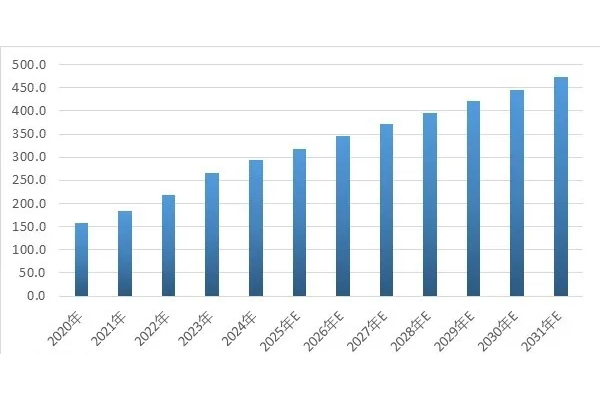
In 2025, China is expected to add 6 new grain-oriented silicon steel
production lines, increasing capacity by 700,000 tons, mainly
concentrated in North China and Central China.
Analysis and Forecast of Downstream Sub-application Areas in the Oriented Silicon Steel Industry
As a key raw material for transformers, reactors, instrument
transformers, and other voltage regulation and transformation equipment,
the development of grain-oriented silicon steel carries the green
mission of energy conservation and emission reduction, and is one of the
important supports for implementing the national “dual-carbon”
strategy. With the support of national strategies and policies,
high-quality grain-oriented silicon steel will have good development
potential.
(1) Conventional Transformers
Driven by national energy policies, China’s smart grid construction has
entered a new stage, and the intelligent transformation of distribution
transformers is accelerating. The State Grid plans to transform 294,800
distribution transformers during the 14th Five-Year Plan period, and the
Southern Power Grid has invested 187 billion yuan in rural power grid
transformation and upgrading. Transformer power loss accounts for about
40% of the transmission and distribution process. In 2023, China’s
transformer power loss was approximately 240 billion kWh, generating 236
million tons of CO2 emissions. Upgrading the grade of grain-oriented
silicon steel will help upgrade transformer energy efficiency, reduce
power loss, improve energy utilization efficiency, and contribute to
carbon emission reduction.
(2) Ultra-High Voltage Projects
With the accelerated construction of wind and photovoltaic power
generation bases, ultra-high voltage transmission has become a key
solution to the problems of new energy grid connection and
cross-regional power transmission. The State Grid Corporation of China
plans to invest 380 billion yuan in ultra-high voltage (UHV) power
transmission projects during the 14th Five-Year Plan period, with UHV
equipment investment accounting for 25%, of which transformer equipment
investment is close to 100 billion yuan. This will drive demand for
supporting equipment and further increase consumption of grain-oriented
silicon steel.
(3) New Energy Power Generation
It is estimated that by the end of the 14th Five-Year Plan period, wind
power and photovoltaic installed capacity will reach 599 million kW and
763 million kW, respectively. By 2030, wind power and photovoltaic
installed capacity will reach 800 million kW and 1.025 billion kW,
respectively, and by 2050, they will reach 2.2 billion kW and 3.45
billion kW, respectively. New energy power generation requires a large
number of transformers; a 1GW wind power or photovoltaic base requires
500 transformers. It is estimated that by 2025, the investment in the
new energy transformer market will exceed 120 billion yuan, and by 2035,
it will exceed 1 trillion yuan. With the future trend of a significant
increase in wind power and photovoltaic installed capacity, transformers
and upstream grain-oriented silicon steel will also experience
explosive growth. In summary, transformers, as key equipment for power
generation and transmission, are the most important downstream industry
for grain-oriented silicon steel, with silicon steel costs accounting
for approximately 30% to 40% of the production cost of a single
transformer. With the implementation of ultra-high voltage projects
across China, the transformer market is showing a growth trend, and the
significant increase in power transformer production will drive the
growth in demand for grain-oriented silicon steel.


评论
发表评论